



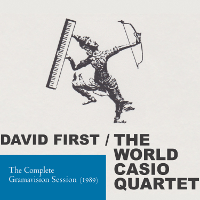
David First / The World Casio Quartet
The Complete Gramavision Session (1989)
Pogus Productions is proud to release The Complete Gramavision Session by The World Casio Quartet, composer David First's 1980s microtonal group. I had the opportunity to see them perform once or twice back then, and it was indeed a magical and mind-bending thing to experience. Now, finally, with this release, everyone can have a listen as well.
Here's what others said about the World Casio Quartet:
First's World Casio Quartet paints the air with sweet-sour chordal splashes that dissolve slowly into transparent harmonics. First describes these pieces as "justly intoned compositions that are not tied to any one tonal center," but others may call them Martian traffic jams, and tuneful ones at that—Mark Dery/Keyboard Magazine Feb '88
David First writes for "lovingly restored" Casios, but the microtones, hair-raising pitch-bendings, and scintillating rhythms he wrenches from them are earning him a reputation as one of New York's most innovative composers—Kyle Gann/Village Voice 11/13/91
This was something unexpected and truly different: pulsing electronic textures that derived their rhythm from the beating patterns of closely-tune pitches – as if Alvin Lucier and Philip Glass had gone on a blind date to CBGBs…David put the beat in beating patterns—composer Nic Collins on the WCQ in his liners notes to First's "Privacy Issues" CD
Their pre-concert tuneup sounds like a hearing test, their live performance is an exercise in visual stasis, and when they're really in the groove the inanimate objects in the room vibrate to a near-shattering point, but the audience remains as still as if it was modeling for an oil painting. Yet, the World Casio Quartet is garnering a reputation as one of the more exciting ensembles on the cutting edge of "new music"—Stanley Mieses/NY Post 5/14/89
The WCQ was born out of a misunderstanding. In 1986 I purchased a Casio CZ1000 digital synthesizer in order to further my ongoing experiments with microtonal drones. Prior to this I had been using an old Heathkit tone generator, overdubbing pitches on a Tascam Portastudio. Using an electronic tuner to measure deviations, I would transcribe my results and have them realized by members of my ensemble at the time, The Flatland Oscillators. Yearning for a more elegant workflow, I began using the Casio for this same purpose. At first, I used the pitch control on the Tascam to bend things toward the relationships I was looking for. But then a better solution revealed itself. As with most synthesizers, it was possible on the CZ1000 to detune one oscillator against a second oscillator to create chorusing effects. Which meant less than nothing to me until, fiddling around one day, I figured out a way to shut off the main oscillator's amplitude envelope, leaving the detunable oscillator, with its 61 discrete steps per ½ step (or 732 pitches per octave), all alone and available for microtonal duties.
I was now able to create repeatable results—with precise detune rates assigned to each pitch. The first work I made I called Four Casios (an homage to Steve Reich's Four Organs), and I began including it on demos I sent to potential performance spaces, on grant applications, etc, with the cheeky appellation "The World Casio Quartet". I probably should have known that people would not realize that it was a bit of a send-up and, indeed, that was exactly what happened—not long after the first batch went out I received a request from a space that was interested in arranging a performance by The World Casio Quartet.
Luckily, I was already beginning to think in this direction anyway. I was growing weary of asking people to interpret my scores on instruments not truly designed for such things. And since these CZ1000s were fairly inexpensive ($259 as I recall) and so ubiquitous at the time, it was easy to find three other members of my ensemble that already had one. And thus the work (and fun) began.
From 1987 to 1991, the WCQ was my main compositional outlet. We played live quite often both around NYC and out of town, working through various procedures I'd developed. For the most part this consisted of using the instrument's keys as triggers rather than as pianistic, melody/harmony manipulators—we rarely used more than one at a time. The real action would be happening in the program banks where, for each particular piece, there would be dozens of iterations of the same exact sound differing in the detune rate only (from 0-60). These program banks became the playing arena and the virtuosity was in switching patch buttons smoothly between each new event. There was also real-time use of the detune function itself, whereby one would be asked to execute glissandos between two given values, as well as glacially slow rocking of the good ol' pitchbend wheel. I would often use this last device as a wildcard to subvert and enhance more deliberate, predetermined elements. This was important, as I was always on the hunt for unique flaws in a room during sound check—a window, air duct, or heating pipe that I could get to rattle sympathetically with a particular frequency. Inevitable apologies from the sound person would follow, but I had found just what I was looking for.
The recordings here were done in a single one-day visit to Gramavision Studios in lower Manhattan. Only one piece was released prior, and since the masters were on 2” reels, I hadn't heard the rest till the fall of 2015 when I went with my friend, Garry Rindfuss, to his old stomping grounds, Avatar Studios (née The Power Station), to have them digitally transferred. Listening to the stuff now, I'm struck by how free it all sounds—I had yet to really dive into any microtonal or just-intonation tuning theory and was merely following my ear and intuition. I miss that innocence sometimes…
The Complete Gramavision Session (1989)
Pogus Productions is proud to release The Complete Gramavision Session by The World Casio Quartet, composer David First's 1980s microtonal group. I had the opportunity to see them perform once or twice back then, and it was indeed a magical and mind-bending thing to experience. Now, finally, with this release, everyone can have a listen as well.
Here's what others said about the World Casio Quartet:
First's World Casio Quartet paints the air with sweet-sour chordal splashes that dissolve slowly into transparent harmonics. First describes these pieces as "justly intoned compositions that are not tied to any one tonal center," but others may call them Martian traffic jams, and tuneful ones at that—Mark Dery/Keyboard Magazine Feb '88
David First writes for "lovingly restored" Casios, but the microtones, hair-raising pitch-bendings, and scintillating rhythms he wrenches from them are earning him a reputation as one of New York's most innovative composers—Kyle Gann/Village Voice 11/13/91
This was something unexpected and truly different: pulsing electronic textures that derived their rhythm from the beating patterns of closely-tune pitches – as if Alvin Lucier and Philip Glass had gone on a blind date to CBGBs…David put the beat in beating patterns—composer Nic Collins on the WCQ in his liners notes to First's "Privacy Issues" CD
Their pre-concert tuneup sounds like a hearing test, their live performance is an exercise in visual stasis, and when they're really in the groove the inanimate objects in the room vibrate to a near-shattering point, but the audience remains as still as if it was modeling for an oil painting. Yet, the World Casio Quartet is garnering a reputation as one of the more exciting ensembles on the cutting edge of "new music"—Stanley Mieses/NY Post 5/14/89
David First's Gramavision
Session Liner Notes:
The WCQ was born out of a misunderstanding. In 1986 I purchased a Casio CZ1000 digital synthesizer in order to further my ongoing experiments with microtonal drones. Prior to this I had been using an old Heathkit tone generator, overdubbing pitches on a Tascam Portastudio. Using an electronic tuner to measure deviations, I would transcribe my results and have them realized by members of my ensemble at the time, The Flatland Oscillators. Yearning for a more elegant workflow, I began using the Casio for this same purpose. At first, I used the pitch control on the Tascam to bend things toward the relationships I was looking for. But then a better solution revealed itself. As with most synthesizers, it was possible on the CZ1000 to detune one oscillator against a second oscillator to create chorusing effects. Which meant less than nothing to me until, fiddling around one day, I figured out a way to shut off the main oscillator's amplitude envelope, leaving the detunable oscillator, with its 61 discrete steps per ½ step (or 732 pitches per octave), all alone and available for microtonal duties.
I was now able to create repeatable results—with precise detune rates assigned to each pitch. The first work I made I called Four Casios (an homage to Steve Reich's Four Organs), and I began including it on demos I sent to potential performance spaces, on grant applications, etc, with the cheeky appellation "The World Casio Quartet". I probably should have known that people would not realize that it was a bit of a send-up and, indeed, that was exactly what happened—not long after the first batch went out I received a request from a space that was interested in arranging a performance by The World Casio Quartet.
Luckily, I was already beginning to think in this direction anyway. I was growing weary of asking people to interpret my scores on instruments not truly designed for such things. And since these CZ1000s were fairly inexpensive ($259 as I recall) and so ubiquitous at the time, it was easy to find three other members of my ensemble that already had one. And thus the work (and fun) began.
From 1987 to 1991, the WCQ was my main compositional outlet. We played live quite often both around NYC and out of town, working through various procedures I'd developed. For the most part this consisted of using the instrument's keys as triggers rather than as pianistic, melody/harmony manipulators—we rarely used more than one at a time. The real action would be happening in the program banks where, for each particular piece, there would be dozens of iterations of the same exact sound differing in the detune rate only (from 0-60). These program banks became the playing arena and the virtuosity was in switching patch buttons smoothly between each new event. There was also real-time use of the detune function itself, whereby one would be asked to execute glissandos between two given values, as well as glacially slow rocking of the good ol' pitchbend wheel. I would often use this last device as a wildcard to subvert and enhance more deliberate, predetermined elements. This was important, as I was always on the hunt for unique flaws in a room during sound check—a window, air duct, or heating pipe that I could get to rattle sympathetically with a particular frequency. Inevitable apologies from the sound person would follow, but I had found just what I was looking for.
The recordings here were done in a single one-day visit to Gramavision Studios in lower Manhattan. Only one piece was released prior, and since the masters were on 2” reels, I hadn't heard the rest till the fall of 2015 when I went with my friend, Garry Rindfuss, to his old stomping grounds, Avatar Studios (née The Power Station), to have them digitally transferred. Listening to the stuff now, I'm struck by how free it all sounds—I had yet to really dive into any microtonal or just-intonation tuning theory and was merely following my ear and intuition. I miss that innocence sometimes…
